
HomeSPICE Assessments
SPICE Assessments

Independent. Insightful. Effective.

How our assessments are structured – and why they drive real improvement.

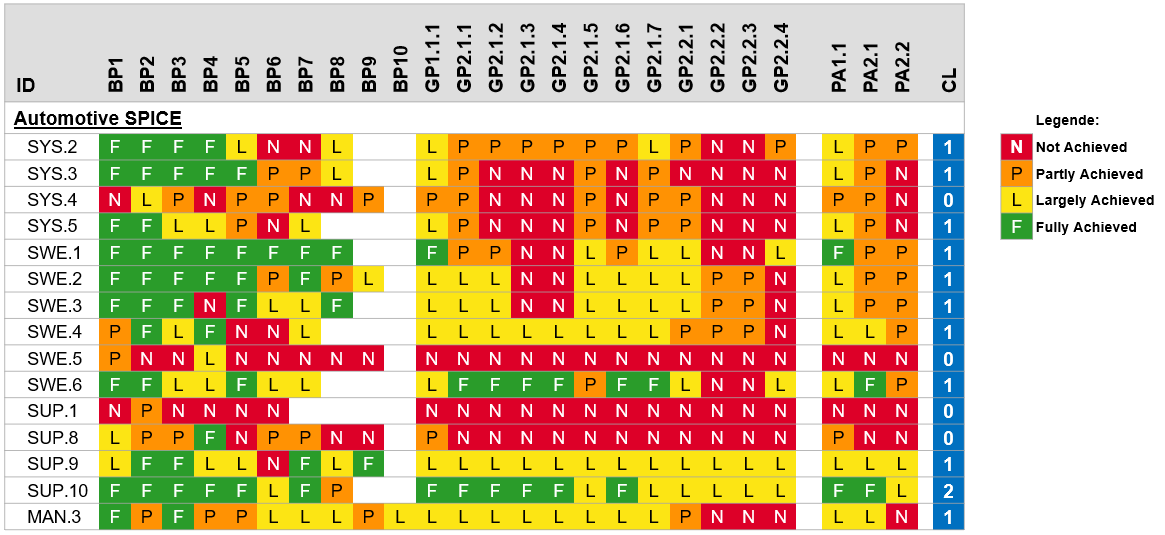
Assessment result matrix – rating of Base Practices, Generic Practices, and Process Attributes per process
The rating isn't everything. Identifying strengths and weaknesses in the development process together is the main task.
How an Assessment Works

Independent. Insightful. Effective.

It starts with getting to know each other—the sponsor or assessment coordinator, but also the project and the product. This is the foundation for defining an appropriate assessment scope.

Formal assessments conducted under the Automotive SPICE® Guidelines and INTACS® rules are always carried out by at least two certified assessors. The lead assessor must maintain independence—meaning they must not have previously worked on the project as a consultant or even as a developer.

There is some flexibility in staffing the co-assessor role. In some cases, a quality staff member from the client organization serves as co-assessor; in others, it's another assessor from the consulting firm. This approach doesn't conflict with the required independence and leads to excellent knowledge transfer.

Good processes are recognizable by how well they fit the company, the product, and the project team—not by how closely they mirror the wording of the Automotive SPICE® reference process word for word.

Both the positive observations and the weaknesses identified together are compiled into an assessment report. In a typical CL2 assessment covering 15 processes with about 6 days of interviews, this can quickly result in a report of over 100 pages.

A 60–75-minute feedback presentation is then held on the final day, addressed to all interview participants and to management. Clearly worked-out weaknesses and improvement suggestions form the starting point for helping the organization help itself.

With the assessments carried out by our experienced assessors, we see clearly in the vast majority of cases that a substantial portion of the identified weaknesses have been resolved by the time of later assessments.

At a Glance

Four Assessment Types at a Glance

Not every initiative requires a full Capability Level assessment. The overview below shows which type fits your needs – from a quick, informal check to organization-wide certification.

Criteria Gap Analysis Formal CL Assessment Standard Process Check Organization-Wide ML Assessment
Best For A quick, informal status check without the effort of a formal assessment. Determining a recognized, traceable maturity level (Capability Level, CL) – e.g. for customer requirements or supplier evaluations. Verifying whether a standard process is fundamentally suitable. Company-wide certification of maturity across multiple projects.
Team & Qualification 1 assessor, at least a certified Provisional Assessor. 2–5 assessors; lead at least a Competent Assessor, co-assessors at least Provisional Assessor. 2–5 assessors; lead at least a Competent Assessor, co-assessors at least Provisional Assessor. 2–5 assessors; lead at least a Principal Assessor (Saphire supervision), at least 1 co-assessor a Competent Assessor.
Duration & Effort approx. 2–3 days for 15 processes. approx. 6–7 days for 15 processes up to CL2, +1 day for CL3. approx. 6–7 days for 15 processes up to Level 3. ≈ 5x the effort of a CL assessment, plus a surveillance assessment after 12 and 24 months.
Rating Method PAs rated with a simplified traffic-light scale; no CL rating. All BPs, GPs, PAs rated on the N-P-L-F scale; CL is calculated. All BPs, GPs, PAs rated with a traffic-light scale; no CL rating. Rating per project instance; results in an organization-wide Maturity Level (ML).
Outcome Feedback presentation + Excel export. No formal report, no assessment log. Plus a formal report (~100 pages) with CL rating. Plus a formal report (~100 pages), without CL rating. Report (100+ pages) + ML certificate, valid for 3 years.
Request an Assessment